
What Should I Do If I Get Scammed By a Moving Company?
Moving scams can be devastating. Whether a company dramatically increased your price, held your belongings hostage, disappeared after taking a deposit, damaged your items, or misrepresented who they were, it's important to act quickly.
The good news is that there are government agencies, consumer protection organizations, and financial institutions that may be able to help. The faster you document what happened and begin filing complaints, the stronger your case will be.
Learn more about avoiding moving scams.
Step 1: Stay Calm and Start Documenting Everything
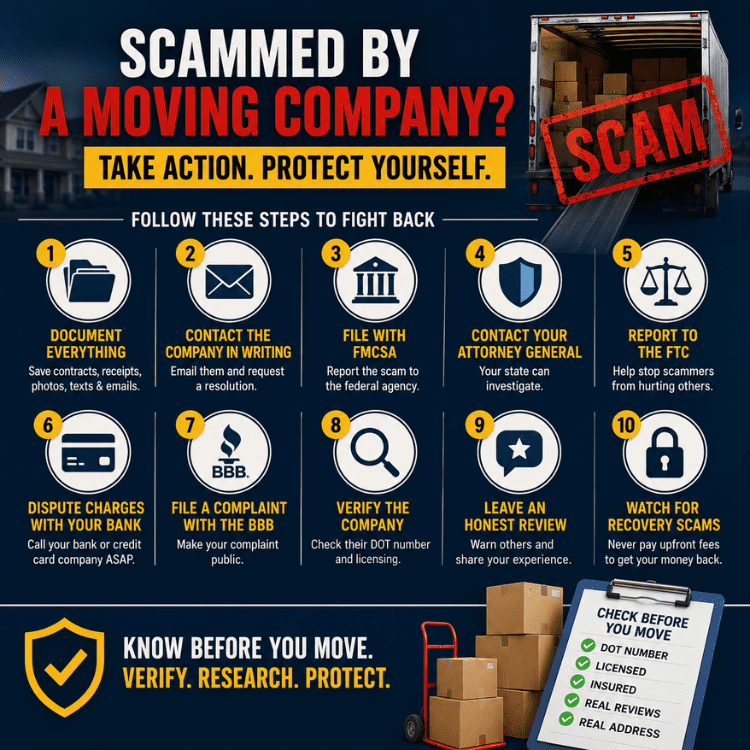
Before making phone calls, gather all available documentation.
Create a folder containing:
- Moving estimate
- Bill of Lading
- Contract
- Emails
- Text messages
- Screenshots of advertisements
- Company website screenshots
- Credit card receipts
- Bank statements
- Photos of damages
- Photos of the moving truck
- Names of employees involved
- DOT and MC numbers
Create a timeline showing:
- Date of estimate
- Date of pickup
- Date of delivery
- Promised price
- Actual charges
- What happened and when
The more organized you are, the easier it will be for agencies to investigate.
Step 2: Determine What Type of Scam Occurred
Different agencies handle different problems.
Hostage Load
The mover refuses to deliver your belongings unless you pay additional money.
Bait-and-Switch Estimate
The mover quoted one price but dramatically increased the cost after pickup.
Broker Misrepresentation
You thought you hired a mover but actually hired a broker.
Deposit Scam
The company collected a deposit and disappeared.
Damage or Loss Claims
Property was damaged, destroyed, or never delivered.
Identity Theft Concerns
You provided sensitive information that may be misused.
Copy Cat Movers
Movers have been posing as legitimate and reputable moving companies by using their name.
Step 3: Contact the Moving Company in Writing
Always communicate in writing.
Email is best.
Clearly state:
- What happened
- What resolution you want
- Deadline for response
For example:
"I am requesting delivery of my shipment at the agreed-upon rate and a written explanation for the additional charges."
Avoid emotional language.
Stick to facts.
Step 4: File a Federal Moving Complaint
If your move crossed state lines, the Federal Motor Carrier Safety Administration (FMCSA) regulates the company.
FMCSA National Consumer Complaint Database
National Consumer Complaint Database
FMCSA Consumer Hotline
1-888-368-7238
FMCSA Protect Your Move
FMCSA tracks complaints involving:
- Interstate movers
- Household goods carriers
- Brokers
- Hostage loads
- Delivery delays
- Estimate disputes
Step 5: Contact Your State Attorney General
Many moving scams violate state consumer protection laws.
Attorney General offices often investigate:
- Deceptive advertising
- Consumer fraud
- Bait-and-switch tactics
- Unlicensed moving operations
Find Your Attorney General
National Association of Attorneys General Directory
If enough complaints are filed, the Attorney General may open an investigation.
Step 6: Report the Company to the Federal Trade Commission
The FTC collects reports involving deceptive business practices.
Report Fraud
FTC Consumer Protection
Federal Trade Commission Consumer Protection
The FTC cannot recover your money directly but uses reports to identify patterns of fraud.
Step 7: Contact Your Credit Card Company Immediately
If you paid by:
- Visa
- Mastercard
- American Express
- Discover
You may be eligible for a chargeback.
Call the number on the back of your card and explain:
- Services were not delivered
- Price changed dramatically
- Goods were withheld
- Misrepresentation occurred
Provide:
- Contract
- Emails
- Photos
- Complaint numbers
Many consumers recover money through chargebacks when they act quickly.
Step 8: Contact Your Bank
If payment was made by:
- ACH transfer
- Wire transfer
- Debit card
Call your bank immediately.
Some transactions can be disputed or flagged as fraud if reported quickly.
Step 9: File a Better Business Bureau Complaint
The BBB cannot force a refund, but many companies respond because public complaints affect their reputation.
BBB Complaint Portal
Include:
- Dates
- Documents
- Amount paid
- Desired resolution
Step 10: Report Identity Theft Concerns
Some scam operations collect sensitive personal information.
If you shared:
- Social Security number
- Driver's license
- Passport information
- Bank details
Monitor your accounts.
Identity Theft Reporting
Identity Theft Hotline
1-877-438-4338
Step 11: Verify the Company's Licensing
Many consumers discover too late that the company was not who they thought it was.
Always check:
FMCSA Company Search
Search by:
- DOT Number
- MC Number
- Legal Name
Review:
- Operating authority
- Safety history
- Inspection results
- Number of trucks
- Number of drivers
Step 12: Leave Honest Reviews
Help protect future consumers.
Leave factual reviews on:
- Yelp
- Better Business Bureau
- Industry directories
Focus on:
- Dates
- Pricing changes
- Communication issues
- Delivery problems
- Claim outcomes
Avoid exaggeration and stick to verifiable facts.
Step 13: Consider Small Claims Court
If damages are within your state's small claims limits, you may be able to pursue recovery without hiring an attorney.
Bring:
- Contracts
- Estimates
- Photos
- Complaint records
- Payment records
Check your local court's filing requirements.
Step 14: Contact Local Law Enforcement (When Appropriate)
If a company:
- Refuses to disclose the location of your shipment
- Threatens you
- Forges documents
- Takes payment and disappears
You may wish to file a police report.
While many moving disputes are civil matters, fraud and theft can become criminal issues.
Step 15: Watch Out for Recovery Scams
Unfortunately, some scammers target victims a second time.
Be cautious of anyone who promises:
- Guaranteed refunds
- Immediate recovery of funds
- Special access to government investigators
Especially if they demand upfront fees.
Legitimate government agencies do not charge consumers to file complaints.
Moving Scam Checklist
- ☐ Save all contracts, estimates, receipts, emails, and text messages
- ☐ Stop relying on phone calls—communicate in writing whenever possible
- ☐ Email the moving company and request a written resolution
- ☐ File a complaint with the FMCSA
- ☐ Contact your credit card company or bank immediately
- ☐ Report the incident to the FTC
- ☐ Contact your State Attorney General's Office
- ☐ Create a timeline and document everything that occurred
- ☐ Verify the mover's DOT number and operating authority
- ☐ Leave factual reviews to help protect other consumers
- ☐ Check whether you hired a carrier or a broker
- ☐ Keep copies of all complaint confirmations and case numbers
The moving industry contains many excellent, ethical movers. Unfortunately, it also contains brokers, lead generators, and dishonest operators who rely on consumers not knowing where to turn. Acting quickly can make all the difference.Movers Near Me is changing the way consumers find moving companies by focusing on transparency instead of advertising. Rather than ranking movers based on who pays the most for leads or sponsored placements, Movers Near Me helps consumers research ownership, DOT records, safety history, operating locations, services, and company backgrounds before requesting a quote. Our mission is simple: give customers access to real information so they can make informed decisions and connect directly with licensed, insured movers—without the confusion of broker networks, lead generation websites, or paid rankings.
Frequently Asked Questions About Moving Scams
What should I do first if I think I was scammed by a moving company?
Save all contracts, estimates, receipts, emails, text messages, and photos. Then contact the company in writing and begin filing complaints with the FMCSA, FTC, your Attorney General, and your payment provider.
Who do I report a moving scam to?
You can report moving scams to the FMCSA, Federal Trade Commission (FTC), Better Business Bureau (BBB), and your state's Attorney General's Office.
What is a hostage load?
A hostage load occurs when a mover refuses to deliver your belongings unless you pay unexpected fees or inflated charges that were not part of the original agreement.
Can I dispute moving company charges with my credit card?
Yes. If the company failed to provide the agreed-upon service or misrepresented the move, contact your credit card company immediately and request a chargeback.
How do I verify a moving company's DOT number?
Visit the FMCSA SAFER database and search the company's DOT number, MC number, or legal name to review licensing, safety records, and operating authority.
What is the difference between a moving broker and a moving carrier?
A carrier owns trucks and performs the move. A broker arranges transportation with another company. Consumers should always understand which type of company they are hiring.
Can I get my money back after a moving scam?
Possibly. Recovery options include credit card chargebacks, bank disputes, small claims court, and regulatory complaints. The faster you act, the better your chances of recovering funds.