










The Complete Senior Moving Guide: How to Plan a Safe, Organized Move
Moving later in life is rarely just a matter of packing boxes.
A senior move may involve leaving a longtime family home, sorting through decades of belongings, coordinating medications or mobility equipment, adjusting to a smaller space, and making difficult decisions with adult children or caregivers. The destination may be a smaller house, an apartment near family, an independent-living community, assisted living, memory care, or a relative’s home.
The most successful senior moves protect three things at once:
- The older adult’s safety
- The family’s time and finances
- The senior’s independence, preferences, and dignity
This guide explains how to plan the move, downsize without becoming overwhelmed, hire the right professionals, avoid moving scams, prepare the new home, and make moving day less stressful.
Important: This guide provides general planning information. Medical, legal, insurance, Medicaid, and financial questions should be confirmed with the appropriate licensed professional or government agency.
Suggested image: An older adult and an adult child reviewing a moving plan at a kitchen table.
Alt text: Senior woman and adult daughter reviewing a senior moving checklist together.
Senior Moving at a Glance
A well-organized senior move generally follows this order:
- Decide where the older adult will live.
- Measure the new residence.
- Establish a budget and moving date.
- Create a written inventory.
- Decide what will fit in the new home.
- Sort belongings into keep, family, sell, donate, recycle, and discard categories.
- Hire a verified moving company.
- Consider whether a senior move manager is needed.
- Coordinate medical care, medications, transportation, and mobility equipment.
- Prepare the new home before moving day.
- Pack a separate essentials bag.
- Set up the bedroom, bathroom, medications, lighting, and familiar objects first.
- Help the older adult establish a new routine after the move.
What Is a Senior Move?
A senior move is a household relocation that includes the needs and circumstances of an older adult.
It may involve:
- Downsizing from a large family home
- Moving closer to children or other relatives
- Relocating to an accessible apartment
- Moving into independent living
- Moving into assisted living
- Entering a memory-care community
- Moving to a skilled-nursing facility
- Moving in with an adult child
- Relocating after the death of a spouse
- Moving after hospitalization, injury, or a change in mobility
- Leaving a home that is becoming difficult or expensive to maintain
Not every senior move involves illness or loss of independence. Many older adults move because they want less home maintenance, better weather, more social opportunities, easier transportation, or closer access to family.
The National Institute on Aging encourages families to consider housing, transportation, health, safety, and access to support services before an urgent need develops.
Why Senior Moves Are Different
The home may represent decades of memories
A longtime home can hold family photographs, inherited furniture, children’s belongings, collections, holiday decorations, important documents, and reminders of a spouse or other loved ones.
Telling someone to “get rid of things” can feel dismissive. A better approach is to decide what the older adult most wants to take into the next stage of life.
The move may involve a much smaller space
A three-bedroom home cannot be moved directly into a studio or one-bedroom apartment without careful planning.
Obtain a floor plan and measurements before making decisions about furniture. Measure:
- Doors
- Elevators
- Hallways
- Closets
- Wall space
- Bedroom dimensions
- Living-room dimensions
- Storage areas
- Bathroom access
Do not pay to move furniture that cannot enter or function safely in the new residence.
Health and mobility may affect the plan
Some older adults need additional time, seating, hydration, medication reminders, hearing assistance, mobility support, or transportation that does not require climbing into a moving truck or large vehicle.
These needs should be written into the moving plan rather than handled informally on moving day.
Family members may disagree
Adult children may disagree about:
- Whether a move is necessary
- Where the parent should live
- What the parent can afford
- Who should receive belongings
- Whether possessions should be sold
- How quickly the move should occur
- Who will manage the project
The older adult should remain at the center of the decision whenever they are able to make informed choices.
Choosing the Right Living Arrangement
Before hiring a mover, determine what type of home and support will be appropriate.
Aging in place
Aging in place means remaining in one’s current home while adapting services or the property to changing needs.
This may work when the home is manageable, affordable, reasonably accessible, and close to healthcare, transportation, groceries, family, or community support.
Possible adaptations include:
- Grab bars
- Improved lighting
- Handrails
- A first-floor bedroom
- A walk-in shower
- Reduced tripping hazards
- Meal delivery
- Transportation assistance
- Home-care services
- Yard or household help
The National Institute on Aging recommends planning before extensive support is needed and evaluating whether the home can safely accommodate changes in mobility and daily activities.
Downsizing to a smaller home
A smaller home may reduce maintenance, utility expenses, yard work, and the amount of space that must be cleaned.
Consider whether the new home has:
- Step-free entry
- An elevator
- Adequate parking
- Accessible bathrooms
- Laundry on the same floor
- Safe walking areas
- Nearby medical services
- Reliable transportation
- Space for visitors
- Pet-friendly rules
Independent living
Independent-living communities are generally designed for adults who can live independently but want amenities, social activities, dining options, transportation, or reduced home maintenance.
Services vary widely. Ask what is included and what carries an additional charge.
Assisted living
Assisted-living communities typically provide housing and some level of help with daily activities. Services may include meals, medication assistance, bathing, dressing, transportation, housekeeping, or emergency-response systems.
Assisted living is not the same as a hospital or skilled-nursing facility. The level of care, staffing, licensing, and medical support varies by community and state.
Memory care
Memory-care communities are designed for people living with Alzheimer’s disease or another form of dementia. They generally offer more structured routines, secure environments, and staff trained in dementia care.
Moving to an unfamiliar setting may temporarily increase confusion or agitation for someone with dementia. Families should coordinate closely with medical providers and the receiving community.
Skilled nursing
A skilled-nursing facility provides a higher level of medical or rehabilitative care than independent or assisted living.
A hospital discharge planner, physician, social worker, or care manager may help determine whether this level of care is appropriate.
Moving in with family
Multigenerational living can provide companionship and practical support, but expectations should be discussed before the move.
Clarify:
- Privacy
- Household expenses
- Transportation
- Meals
- Caregiving responsibilities
- Home modifications
- Guests
- Pets
- Respite care
- What will happen if care needs increase
How to Discuss Moving With an Aging Parent
The first conversation should not begin with a truck reservation or a list of things to discard.
Begin with questions:
- What is becoming difficult about the current home?
- What do you enjoy most about living here?
- What would make daily life easier?
- Would you like to live closer to family?
- What are you most worried about losing?
- What would you want your next home to feel like?
- Which possessions matter most to you?
- What would help you feel in control of the move?
Language to avoid
Avoid statements such as:
- “You cannot live here anymore.”
- “You don’t need all this stuff.”
- “We’ve already decided.”
- “This is for your own good.”
- “You need to get rid of everything.”
Even when a move is necessary, overly forceful language can create fear, resistance, or distrust.
Preserve meaningful choices
Not every aspect of the move may be optional, but many decisions can remain with the older adult:
- Which chair to take
- Which photographs to display
- What clothing to keep
- How the bedroom should be arranged
- Who should receive family belongings
- What time of day to move
- Which family member should be present
Small choices can restore a sense of control during a major transition.
Creating a Written Senior Moving Plan
A written plan reduces the chance that important tasks will be lost in text messages, phone calls, or family conversations.
Include the following information:
Move details
- Moving date
- Origin address
- Destination address
- Community move-in hours
- Elevator reservation
- Loading instructions
- Parking restrictions
- Moving-company contact
- Senior move manager contact
- Family coordinator
Health and personal needs
- Medication schedule
- Mobility equipment
- Dietary needs
- Hearing or vision needs
- Emergency contacts
- Physician and pharmacy information
- Required rest periods
- Transportation plan
- Pet plan
Property and belongings
- New-home measurements
- Furniture plan
- Inventory
- Valuable-item list
- Donation plan
- Sale or auction plan
- Storage plan
- Items assigned to relatives
- Items that should not be packed
Responsibility chart
| Task | Person responsible | Deadline |
| Reserve mover | Adult daughter | Eight weeks before |
| Measure new apartment | Senior move manager | Eight weeks before |
| Review medications | Senior and caregiver | Two weeks before |
| Arrange donations | Adult son | Three weeks before |
| Reserve elevator | Family coordinator | Four weeks before |
| Transport valuables | Senior or trusted family member | Moving day |
| Set up bedroom | Movers and family | Before arrival |
| Update address | Family assistant | Within one week |
Senior Moving Timeline
Download our Senior Moving Checklist
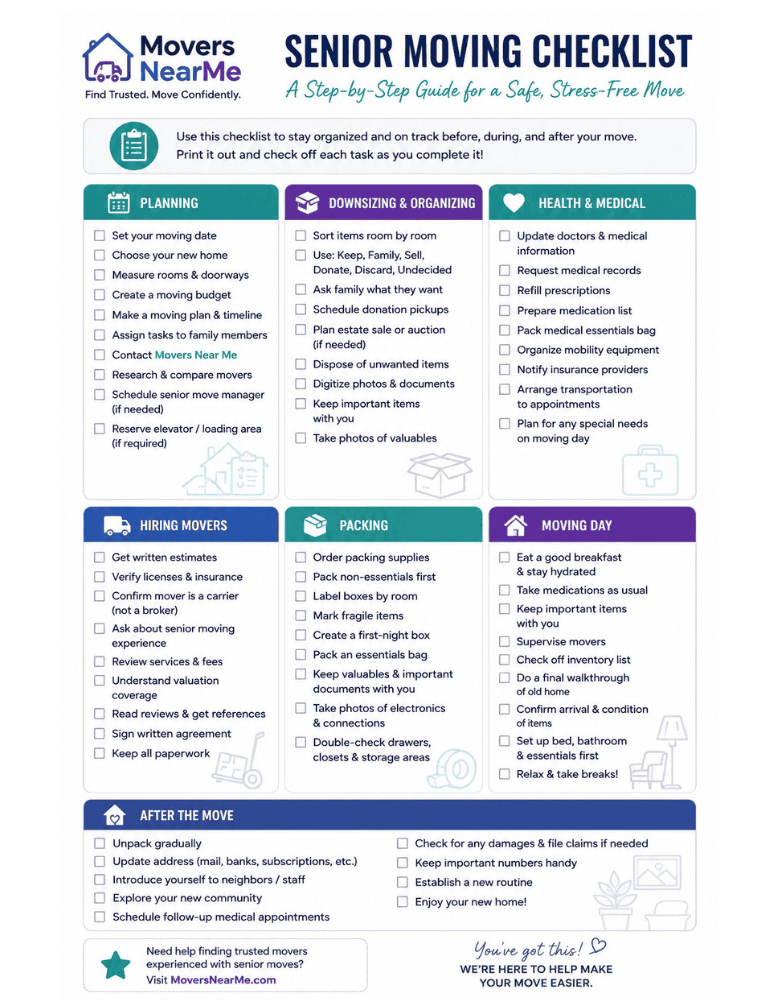
Eight to twelve weeks before the move
- Confirm the destination.
- Obtain the new-home floor plan.
- Measure rooms, doors, and storage areas.
- Create a moving budget.
- Interview moving companies.
- Decide whether to hire a senior move manager.
- Begin sorting low-emotion areas such as linen closets or utility rooms.
- Ask family members what items they genuinely want.
- Review community move-in requirements.
Six weeks before
- Select the movers.
- Get the estimate and terms in writing.
- Create a furniture plan.
- Schedule estate-sale, auction, donation, or junk-removal services.
- Request medical records where needed.
- Identify a new pharmacy and medical providers.
- Begin packing items that are not used daily.
Four weeks before
- Confirm the mover and move-in time.
- Reserve elevators or loading areas.
- Submit certificates of insurance if required.
- Update insurance and service providers.
- Arrange transportation for the older adult.
- Decide where the senior will stay during the most disruptive part of the move.
- Label furniture according to its destination in the new home.
Two weeks before
- Refill essential prescriptions.
- Confirm utility start and stop dates.
- Prepare the moving-day essentials bag.
- Confirm pet arrangements.
- Review the mover’s paperwork.
- Photograph valuable items and consider moving insurance.
- Confirm the new residence will be clean and accessible.
- Pack a first-night box.
Moving week
- Remove trash and donations before the movers arrive.
- Keep medications, documents, valuables, keys, and medical equipment separate.
- Confirm transportation and meals.
- Place brightly colored labels on boxes that must be opened first.
- Review the new-home floor plan with the moving crew.
- Charge phones, hearing devices, medical devices, and backup batteries.
Moving day
- Keep the senior in a quiet, safe location.
- Maintain normal meal and medication times.
- Ensure one person supervises the origin and another receives the shipment when possible.
- Check the inventory.
- Perform a final walkthrough.
- Set up the bedroom, bathroom, lighting, and medications first.
- Place familiar objects where the senior can see them immediately.
The first 30 days
- Finish unpacking gradually.
- Remove boxes and tripping hazards.
- Establish a daily routine.
- Confirm medical appointments and prescriptions.
- Introduce the senior to staff, neighbors, or activities.
- Watch for persistent sadness, confusion, isolation, or difficulty functioning.
- File any moving-damage claim within the mover’s required time period.
A Two-Week Emergency Senior Move
Sometimes a move follows a fall, hospital discharge, sudden loss of a caregiver, lease issue, or immediate safety concern.
When time is limited, prioritize function over perfection.
Days 1–2
- Confirm the destination and move-in date.
- Obtain room measurements.
- Choose one family coordinator.
- Contact movers and senior move managers.
- Identify immediate medical and transportation needs.
Days 3–5
- Select only the furniture and belongings that fit.
- Pack medications, documents, clothing, toiletries, bedding, and familiar items.
- Arrange donation or cleanout services.
- Notify the receiving community.
Days 6–10
- Confirm the mover’s authority and written estimate.
- Label everything by destination room.
- Set aside valuables.
- Arrange utilities, pharmacy, and medical records.
- Prepare the essentials bag.
Days 11–14
- Move the essential furniture first.
- Prepare the bedroom and bathroom.
- Complete the move.
- Leave nonurgent property decisions for later when possible.
Do not force the family to resolve every photograph, collectible, or heirloom during an emergency move. Secure the remaining property and create a second-stage plan.
Downsizing Without Becoming Overwhelmed
Downsizing is often the most emotionally difficult part of a senior move.
Start with the new home, not the old home
Ask:
What should the new home contain for it to be safe, comfortable, familiar, and functional?
This question is usually more productive than asking what must be eliminated.
Use six categories
Label separate areas or boxes:
- Keep
- Give to family
- Sell
- Donate
- Recycle or dispose
- Undecided
Limit the undecided category. Otherwise, it can become a way of postponing every difficult decision.
Suggested image: A senior couple and adult child sorting photographs into labeled boxes.
Alt text: Family sorting belongings into keep, family, and donate boxes before a senior move.
Begin with easier areas
Good starting points include:
- Laundry supplies
- Duplicate kitchen utensils
- Old linens
- Expired pantry items
- Garage supplies
- Unused small appliances
- Extra office supplies
Do not begin with wedding photographs, a deceased spouse’s clothing, or inherited possessions unless the older adult specifically wants to.
Ask family members early
Adult children often say they want family items but never arrange to collect them.
Give relatives a clear deadline. Ask them to:
- Select what they want.
- Confirm that they have space for it.
- Arrange pickup or shipping.
- Accept the cost of transporting it.
A possession has not been successfully reassigned until someone has agreed to take responsibility for it.
Preserve the story without keeping every object
For meaningful items that cannot be moved:
- Photograph them.
- Record the story associated with them.
- Create a digital album.
- Keep one representative piece from a collection.
- Give items to a person who values their history.
- Scan letters, recipes, and documents.
Selling, Donating, and Disposing of Belongings
Estate-sale companies
Estate-sale companies organize and sell household contents, usually in exchange for a percentage of the sale or another agreed fee structure.
Ask:
- What percentage or fee do you charge?
- Are there minimums?
- Who sets prices?
- How are unsold items handled?
- When is payment made?
- Are staff insured?
- Can the company buy items itself?
- Will you provide a written inventory?
- Who pays for advertising, cleanup, and disposal?
Auction companies
Auction companies may be appropriate for valuable collections, antiques, art, vehicles, equipment, or high-demand specialty items.
Request an explanation of commissions, buyer premiums, pickup terms, reserves, photography fees, and unsold items.
Donations
Confirm what the organization accepts before arranging pickup. Many donation services will not take stained furniture, mattresses, hazardous materials, oversized pieces, or damaged goods.
Obtain a receipt when appropriate, but consult a tax professional about deductibility and valuation.
Junk removal and Estate Cleanouts
Junk-removal companies remove unwanted property but do not necessarily transport household goods to a new residence.
Ask whether charges are based on:
- Volume
- Truck space
- Labor
- Weight
- Special disposal fees
- Stairs
- Travel
- Hazardous or restricted materials
Never place personal records, financial statements, medication labels, or identifying documents into unsecured trash. Movers Near Me offers free moving concierge services for seniors. Reach out to us today or review our estate cleanouts page.
What Is a Senior Move Manager?
A senior move manager helps an older adult or family plan and coordinate downsizing, organizing, relocation, and sometimes aging-in-place projects.
Services may include:
- Creating a move plan
- Measuring the new residence
- Developing a floor plan
- Sorting belongings
- Coordinating donations or sales
- Scheduling movers
- Supervising packing and unpacking
- Arranging furniture
- Setting up the new home
- Coordinating cleanouts
NASMM describes senior move managers as professionals who assist older adults and families with organizing, decluttering, downsizing, relocating, or aging in place.
A move manager is not necessarily the mover
A senior move manager may coordinate the project without physically transporting the household goods.
The business that loads and transports the shipment should have the licenses, registrations, insurance, and operating authority required for the move.
Are senior move managers certified?
Senior move management is not governed by one nationwide occupational license. Professional association membership, training, accreditation, and certification are separate from government authorization to operate as a moving carrier.
NASMM offers an SMM-C certification based on coursework, experience, and completion of a minimum number of senior moves. NASMM also offers company accreditation. Those credentials can be useful screening factors, but families should still review insurance, contracts, references, fees, employees, and services.
How to Choose a Senior Moving Company
Determine whether the move is local or interstate
Interstate household-goods moves are regulated federally. Moves entirely within one state are generally governed by state rules, which vary.
For an interstate move, verify the company through FMCSA and review:
- USDOT number
- Operating status
- Household-goods authority
- Legal name and DBA
- Whether it is a carrier or broker
- Insurance information
- Complaint information
- Contact information
FMCSA explains that a carrier accepts responsibility for transporting the goods, while a broker arranges transportation with another company.
Understand the difference between a carrier and broker
A moving carrier operates the move or accepts responsibility for transporting the shipment.
A moving broker sells or arranges the move but may not own the truck or employ the crew that appears on moving day.
A moving broker is not automatically fraudulent, but the consumer should know who will actually perform the move, which company’s authority applies, and who will handle claims. Make sure to read about moving red flags.
Obtain a detailed survey
The mover should obtain enough information to prepare a realistic estimate. This may involve an in-home or live virtual survey.
Disclose:
- Stairs
- Elevators
- Long walking distances
- Large furniture
- Safes
- Pianos
- Medical equipment
- Storage stops
- Packing needs
- Difficult access
- Items not yet sorted
- Furniture requiring disassembly
A low estimate based on incomplete information may increase substantially when the actual work is performed.
Get everything in writing
The written documents should identify:
- Legal company name
- Pickup and delivery addresses
- Services
- Estimated charges
- Hourly or weight-based rates
- Packing fees
- Storage fees
- Additional-service charges
- Valuation selection
- Payment terms
- Cancellation terms
- Delivery window
- Claims process
For interstate moves, the mover or broker must provide the federal Your Rights and Responsibilities When You Movebooklet.
Understand valuation protection
Moving-company valuation is not necessarily the same as ordinary insurance.
For interstate moves, FMCSA states that movers must offer Full Value Protection and Released Value Protection. Released Value generally provides very limited protection, while Full Value Protection creates broader responsibility under the mover’s terms and declared value. Ask the mover to explain exclusions, deductibles, high-value-item declarations, repair options, replacement rules, and claim deadlines. Learn more about moving company insurance.
Compare more than the price
The lowest estimate is not always the least expensive move.
Evaluate:
- Experience with senior moves
- Employee or contractor structure
- Background-screening policies
- Packing ability
- Furniture setup
- Storage
- Claims handling
- Communication
- Arrival windows
- Crew training
- Accessibility experience
- References
- Insurance
- Complaint history
Quick MMoving Inventory Checklist.
Moving Scam Warning Signs
Be cautious when a mover or broker:
- Demands a large deposit or cash payment
- Provides a price far below other estimates
- Refuses to perform a meaningful survey
- Will not identify the legal company name
- Cannot explain whether it is a carrier or broker
- Uses several unrelated company names
- Has no verifiable address
- Answers the phone with a generic phrase
- Pressures you to sign immediately
- Provides blank or incomplete documents
- Arrives in an unmarked rental truck without explanation
- Changes the price after loading
- Refuses to provide federally required information
- Will not explain claims or valuation coverage
FMCSA specifically identifies demands for cash or large deposits and failure to provide required consumer information as warning signs. The FTC also recommends verifying the company’s address, registration, licensing, insurance, and required state information.
What if a mover raises the price?
First determine whether the price changed because the shipment, services, access conditions, or inventory changed.
Do not sign blank or inaccurate documents. Request a written explanation showing:
- What changed
- Why it changed
- Which contractual term applies
- The new total
- What must be paid at delivery
For a federal nonbinding estimate, FMCSA states that a mover generally cannot require more than 110% of the estimate at delivery, although additional lawful charges may remain due later.
What if belongings are being held hostage?
Preserve the estimate, bill of lading, inventory, receipts, payment records, emails, texts, and photographs.
Contact law enforcement when there is an immediate threat or theft concern. Interstate moving complaints can also be filed through FMCSA, and suspected fraud can be reported to the FTC. FMCSA notes that enforcement may apply when a mover knowingly and willfully violates the contract and fails to deliver after required payment has been made.
Senior Moving Costs
There is no single meaningful national price for a senior move.
The total depends on:
- Distance
- Shipment size
- Number of movers
- Stairs and elevators
- Packing
- Unpacking
- Furniture assembly
- Storage
- Specialty items
- Travel
- Senior move management
- Estate-sale or auction fees
- Donations
- Junk removal
- Cleaning
- Repairs
- New-home setup
- Accessibility modifications
- Temporary lodging
- Pet transportation
Sample senior moving budget
| Expense | Estimated | Actual |
| Moving company | ||
| Packing materials | ||
| Packing and unpacking labor | ||
| Senior move manager | ||
| Storage | ||
| Estate sale or auction | ||
| Donations and hauling | ||
| Cleaning | ||
| Repairs | ||
| Travel and lodging | ||
| New furniture | ||
| Accessibility improvements | ||
| Pet expenses | ||
| Contingency fund |
Add a contingency amount for overlooked items, schedule changes, additional packing, storage, or unexpected access problems.
Does Medicare or Medicaid Pay for a Senior Move?
Medicare
Ordinary household moving costs are not a standard benefit under Original Medicare. Original Medicare also does not generally cover long-term custodial care. Some Medicare Advantage plans, PACE programs, or other coverage may offer benefits not included in Original Medicare, but benefits and eligibility must be confirmed directly with the plan.
Medicaid
Medicaid home- and community-based services vary substantially by state and program. Certain waiver or transition programs may cover approved setup or transition-related expenses when an eligible person moves from an institutional setting into a community setting. This does not mean Medicaid generally pays for ordinary household moves.
Contact the state Medicaid agency or the participant’s case manager before assuming that any expense will be reimbursed.
Area Agencies on Aging
Area Agencies on Aging coordinate local services and may help families locate transportation, home support, meals, caregiver services, benefits counseling, and other community resources.
The federal Eldercare Locator connects families with local aging services and Area Agencies on Aging.
Medical and Medication Planning
Never place essential medications or medical devices on the moving truck.
Prepare a clearly marked medical bag containing:
- Current medications
- Several days of backup medication when available
- Medication list
- Dosage schedule
- Physician information
- Pharmacy information
- Insurance cards
- Allergies
- Emergency contacts
- Eyeglasses
- Hearing aids and batteries
- Mobility-device accessories
- CPAP or respiratory equipment
- Chargers
- Refrigeration supplies for temperature-sensitive medication
- Basic toiletries
- Water and a snack
Confirm transportation and storage requirements for medical equipment with the prescribing provider, equipment supplier, or receiving community.
Moving a Person With Dementia
A move can be especially disorienting for someone with dementia.
Prepare the new room first
Whenever possible, arrange the bedroom or apartment before the person arrives.
Use:
- Familiar bedding
- Family photographs
- A recognizable chair
- A favorite blanket
- Familiar artwork
- Clearly visible bathroom access
- Simple labels
- Good lighting
- A clock and calendar
Keep the day calm
Reduce noise, crowds, and unnecessary decisions. Maintain familiar meal, medication, and sleep routines as closely as possible.
Choose the best time of day
Plan transportation for a time when the person is usually calm and alert. Avoid an unnecessarily long or complicated journey.
Supervise continuously
New or changed surroundings can increase the risk of confusion or wandering. The Alzheimer’s Association advises against leaving a person with dementia unsupervised in unfamiliar surroundings.
Coordinate with the receiving community
Provide staff with:
- Preferred name
- Daily routine
- Food preferences
- Comforting activities
- Medication information
- Communication needs
- Personal history
- Known stressors
- Sleep routine
- Wandering risk
- Emergency contacts
Person-centered information helps the staff see the individual rather than only the diagnosis.
Preparing the New Home
The new residence should be safe and functional before boxes take over the space.
Reduce fall hazards
- Remove loose rugs.
- Keep pathways clear.
- Secure cords.
- Improve lighting.
- Avoid unstable furniture.
- Keep frequently used items within easy reach.
- Install appropriate handrails or grab bars.
- Ensure the bed is at a usable height.
- Provide a clear path to the bathroom.
The National Institute on Aging recommends removing home hazards, improving access to frequently used items, and evaluating bathrooms, stairs, lighting, and walking surfaces to reduce fall risk.
Arrange furniture for function
Leave enough space for:
- A walker
- Wheelchair turning
- Caregiver assistance
- Safe transfers
- Access to windows and doors
- Emergency personnel
- Nighttime bathroom trips
Do not recreate the old home so precisely that the new space becomes crowded or unsafe.
Moving-Day Essentials Bag
The moving-day bag should stay with the senior, family member, or caregiver.
Pack:
- Medications
- Identification
- Insurance cards
- Important contact information
- Legal and medical documents
- Phone and charger
- Keys
- Wallet
- Eyeglasses
- Hearing aids
- Mobility-device supplies
- Change of clothing
- Pajamas
- Toiletries
- Comfortable shoes
- Water
- Snacks
- Favorite comfort item
- Pet supplies
- Basic cleaning items
- Toilet paper and paper towels
Suggested image: A navy moving-day bag beside medications, glasses, documents, clothing, keys, and water.
Alt text: Senior moving-day essentials bag with medication, documents, clothes, glasses, charger, and water.
Questions to Ask a Moving Company
- What is your legal company name?
- Are you the carrier or a broker?
- What is your USDOT number?
- Will your employees perform the move?
- Do you subcontract any part of the move?
- Who will arrive on moving day?
- Is the estimate binding or nonbinding?
- What could cause the price to increase?
- What deposit is required?
- When is final payment due?
- What payment methods do you accept?
- Is packing included?
- Are boxes and materials included?
- Can you pack medications or medical equipment?
- Do you provide unpacking and furniture placement?
- What valuation options are available?
- How are damage claims handled?
- Do you offer storage?
- Are there charges for stairs, elevators, or long carries?
- What is the pickup and delivery window?
- What happens if the senior community changes the move-in time?
- Can you provide proof of insurance?
- Will you provide a written inventory?
- Have you handled moves into senior communities?
- What is your cancellation policy?
Questions to Ask a Senior Move Manager
- Which services do you provide directly?
- Which services do you coordinate through other companies?
- Do you transport household goods?
- Are you insured?
- Do you use employees or contractors?
- Are background checks performed?
- What training or certification do you hold?
- Do you charge hourly, by project, or both?
- Is there a minimum charge?
- Can you create a floor plan?
- Can you supervise packing and unpacking?
- Can you coordinate donations and estate sales?
- Do you receive compensation from referred vendors?
- How are valuables documented?
- Who will work inside the home?
- Can you coordinate with assisted-living or memory-care staff?
- What happens when the project takes longer than expected?
- Can you provide references?
- How do you protect confidential information?
- What is included in the written agreement?
Master Senior Moving Checklist
Planning
- Confirm the destination.
- Set the moving date.
- Obtain a floor plan.
- Measure furniture and entrances.
- Create a budget.
- Choose a family coordinator.
- Create an emergency contact list.
Hiring professionals
- Compare moving companies.
- Verify licenses or authority.
- Determine carrier or broker status.
- Review estimates.
- Choose valuation protection.
- Interview senior move managers.
- Schedule donations, sales, or cleanout services.
Downsizing
- Identify essential furniture.
- Ask relatives what they want.
- Sort room by room.
- Photograph sentimental items.
- Arrange pickups.
- Secure valuables and records.
- Dispose of identifying documents safely.
Medical preparation
- Refill prescriptions.
- Transfer pharmacy information.
- Obtain medical records.
- Confirm medical-equipment arrangements.
- Prepare medication list.
- Prepare the medical essentials bag.
- Confirm transportation.
Packing
- Pack nonessential items first.
- Label every box by room.
- Mark priority boxes.
- Photograph valuable items.
- Keep documents and medications separate.
- Prepare the first-night box.
- Prepare pet supplies.
Moving day
- Maintain meals and medication schedule.
- Keep the senior in a calm location.
- Supervise loading.
- Review the inventory.
- Complete the final walkthrough.
- Set up the bedroom and bathroom.
- Remove boxes from walking paths.
After the move
- Confirm medications and medical care.
- Update addresses.
- Introduce neighbors or community staff.
- Establish a daily routine.
- Remove remaining tripping hazards.
- Review mover damage.
- File claims promptly.
- Schedule family visits and activities.
Senior Moving FAQs
These answers are intentionally direct and self-contained so they can be understood by readers, search engines, and AI answer systems.
What is a senior moving service?
A senior moving service helps older adults plan, organize, pack, move, unpack, or downsize. The term may refer to a traditional moving company, a senior move manager, or a business offering both types of assistance. Consumers should verify exactly which services the company performs.
What does a senior move manager do?
A senior move manager coordinates downsizing and relocation tasks. Services may include sorting belongings, creating a floor plan, arranging donations, hiring movers, supervising packing, unpacking boxes, and setting up the new home. A senior move manager is not automatically licensed to transport household goods.
How much does a senior move cost?
The cost of a senior move depends on distance, shipment size, labor, packing, storage, senior move management, cleanout services, specialty items, and new-home setup. Families should request written estimates for each service rather than relying on one national average.
How far in advance should a senior move be planned?
A senior move should ideally be planned at least eight to twelve weeks in advance. More time may be needed when the move involves selling a home, extensive downsizing, estate sales, medical coordination, interstate transportation, or entry into a senior living community.
How do I find senior movers near me?
Search for moving companies that specifically describe senior moving, downsizing, packing, unpacking, and assisted-living moves. Verify state licensing for local moves or FMCSA registration for interstate moves. Ask whether the company is the carrier or a broker and request a detailed written estimate.
Does Medicare pay for senior moving expenses?
Original Medicare does not ordinarily pay for household moving expenses. A Medicare Advantage plan, PACE program, Medicaid waiver, long-term-care policy, veterans program, or local assistance program may provide limited help in certain circumstances. Eligibility must be confirmed directly with the program.
Does Medicaid help pay for moving?
Some state Medicaid home- and community-based programs may cover approved transition or setup expenses for eligible participants, particularly when someone is moving from an institution into a community setting. Coverage is state- and program-specific and should not be assumed.
What is the difference between a moving company and a moving broker?
A moving company or carrier accepts responsibility for transporting the household goods. A moving broker arranges the move with another company. Consumers should know which business will perform the move and whose operating authority and insurance apply.
Are senior move managers licensed?
There is no single nationwide license for the senior move management profession. Some professionals hold association certifications or accreditations. A senior move manager who also transports household goods must comply with the mover-licensing or registration requirements that apply to that transportation.
Should a senior be present on moving day?
A senior may be present if they want to be and can remain comfortable and safe. However, some families arrange for the older adult to spend the busiest hours with a relative, caregiver, or community staff member to reduce noise, physical risk, and stress.
What should a senior keep with them during the move?
A senior should personally keep medications, identification, insurance cards, legal and medical documents, keys, valuables, eyeglasses, hearing aids, chargers, mobility-device supplies, water, snacks, toiletries, and a change of clothing. These items should not be placed on the moving truck.
How do you help an elderly parent downsize?
Begin with the dimensions of the new home and identify what the parent most wants to keep. Sort one room at a time using keep, family, sell, donate, recycle, discard, and undecided categories. Avoid starting with the most emotional possessions.
How do you move someone with dementia?
Prepare the new room before arrival, maintain familiar routines, display recognizable belongings, minimize noise, move during the person’s best time of day, and provide continuous supervision. Coordinate the transition with healthcare providers and the receiving care community.
Can movers unpack and arrange furniture?
Many full-service movers offer unpacking, furniture assembly, and basic furniture placement for an additional charge. Confirm the service in writing. A senior move manager may provide more detailed home setup, including arranging closets, kitchens, photographs, and personal belongings.
How can I verify an interstate moving company?
Use FMCSA’s mover-search and consumer-protection resources to confirm the company’s USDOT number, authority, legal name, insurance information, carrier or broker status, and complaint information. Verify that the name on the estimate matches the federal record.
What are the biggest senior moving scam warning signs?
Major warning signs include a very low quote, a demand for a large deposit or cash, refusal to perform a meaningful survey, missing licensing information, blank documents, unidentified subcontractors, generic phone answering, and major price increases after the shipment is loaded.
What should I do if a mover raises the price after loading?
Ask for a written explanation and compare the new charges with the estimate, inventory, order for service, and bill of lading. Do not sign inaccurate or blank paperwork. Preserve all evidence and contact FMCSA for an interstate move or the applicable state regulator for a local move.
Is assisted living the same as a nursing home?
No. Assisted living generally combines housing with personal-care support, while a skilled-nursing facility provides a higher level of nursing or rehabilitative care. Services, staffing, licensing, and eligibility vary by state and facility.
What should be unpacked first after a senior move?
Unpack the bed, bathroom supplies, medications, clothing, lighting, phone charger, mobility equipment, kitchen basics, and familiar personal objects first. Clear walking paths immediately and remove boxes that create fall hazards.
How can families make a new home feel familiar?
Use the senior’s existing bedding, favorite chair, photographs, lamps, artwork, clock, books, and familiar arrangement where practical. Recreating recognizable visual cues can make the new home feel less unfamiliar without overcrowding the space.
Final Thoughts
A senior move should not be rushed simply because the physical distance is short.
The best outcomes come from beginning early, preserving the older adult’s choices, measuring the new space, hiring properly verified professionals, protecting medications and documents, and preparing the new residence before the senior arrives.
The objective is not to move every possession from one address to another. It is to create a safe, comfortable, and recognizable home for the next stage of life.
MoversNearMe.com helps families research moving companies and understand the difference between movers, brokers, van-line agents, and other relocation professionals. Families should still independently verify every provider, read all agreements, and choose services based on the specific needs of the older adult.