









Moving Truck Rental Guide
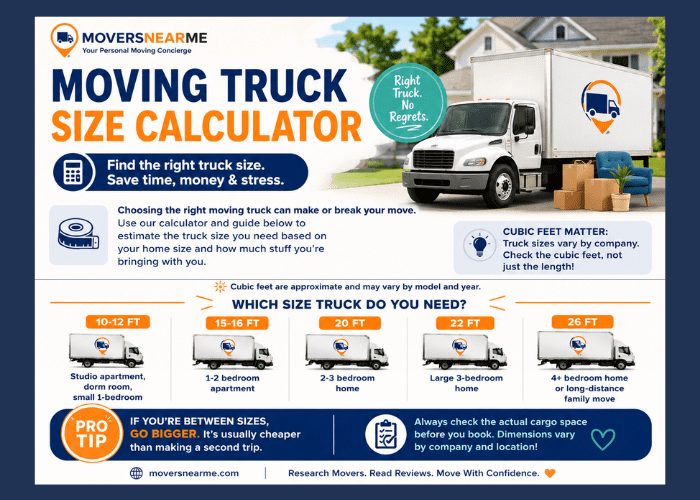
Renting a moving truck sounds simple — until you get to the checkout screen and realize the per-mile charges, fuel costs, equipment fees, and insurance have doubled your estimate. Choosing the right truck rental company depends entirely on how far you're moving, how much stuff you have, and how long you need the truck. This guide breaks down the major players, what they're actually best for, the questions you must ask before booking, and a few insider tips that can save you hundreds of dollars. Find out what size moving truck you need.
The Major Players: Who They Are and What They're Best For
U-Haul — Best for Short Local Moves Under 20 Miles
U-Haul is the most recognizable name in DIY moving and for good reason — they have more locations than anyone else, making pickup and drop-off incredibly convenient. However, U-Haul's pricing model is built around per-mile charges, and those miles add up faster than most people expect.
For a local move under 20 miles, U-Haul is often the most affordable option. The base rate is low, and you're not driving far enough for the mileage fees to hurt. But take that same truck 200 miles and the cost can become surprisingly high compared to competitors who offer unlimited mileage.
U-Haul is ideal for: apartment moves, single-room moves, college student moves, and short in-town relocations where you'll return the truck to the same location or a nearby drop-off. Their network of neighborhood dealers — gas stations, storage facilities, hardware stores — means you can almost always find one close to home.
Watch out for: per-mile charges on one-way moves, fuel return requirements, and the cost of adding a dolly, furniture pads, and other equipment that is not included in the base rate.
Penske — Best for Large Household Moves
Penske is widely considered the premium option in the consumer truck rental market, and their equipment reflects that. Penske trucks are typically newer, better maintained, and come with features like automatic transmissions, air conditioning, and built-in ramps that make loading large furniture significantly easier.
Penske is the go-to choice for large household moves — three-bedroom homes and above — particularly when you're moving a significant distance. They offer unlimited miles on most one-way rentals, which makes the total cost more predictable than U-Haul for longer hauls.
Penske also tends to have stronger customer service and cleaner vehicles. The base price is higher than U-Haul, but for a large move where equipment reliability matters, the premium is often worth it. They are also a solid choice for moves that involve valuable furniture, antiques, or fragile items where a well-maintained truck with a proper loading ramp makes a real difference.
Budget Truck Rental — Best for Long-Distance Moves with Unlimited Miles
Budget Truck Rental (not to be confused with Budget car rental, though they are related) is one of the best-kept secrets in long-distance moving. Budget frequently offers unlimited mileage on one-way rentals, which makes them highly competitive for cross-country or multi-state moves where mileage charges would otherwise be a major cost driver.
If you're moving from one coast to another or relocating across multiple states, Budget's unlimited mileage pricing can save you hundreds compared to per-mile competitors. Their fleet is older than Penske's but generally reliable, and their rates are often lower overall.
Budget is ideal for: cost-conscious movers doing long-distance one-way moves, people relocating for work, and anyone moving a modest amount of belongings a very long distance. Always confirm that the specific reservation includes unlimited miles — promotional availability varies by location and season.
Enterprise Truck Rental — Best for Flexible Short-Term Rentals
Enterprise is primarily known as a car rental company, but they do offer moving trucks in select markets. Their truck fleet is smaller and less widely available than U-Haul or Penske, but Enterprise locations tend to offer excellent customer service, flexible rental terms, and the ability to bundle a moving truck with a car rental if needed.
Enterprise is a good option if you need flexibility, are moving within a market where they have strong truck availability, or want the reliability of a major rental brand with easy billing. Check availability early, as their truck inventory is more limited.
Ryder — Best for Commercial and Business Moves
Ryder is primarily a commercial fleet and logistics company, but they do offer consumer truck rentals through their consumer division. Ryder trucks are well-maintained commercial-grade vehicles, and the company is a solid option for large moves, business relocations, or anyone who needs a heavy-duty truck with confidence in the equipment.
Ryder's consumer presence is smaller than U-Haul or Penske, so availability may be limited in some markets. For commercial moves, office relocations, or industrial equipment transport, Ryder's commercial expertise makes them a strong consideration.
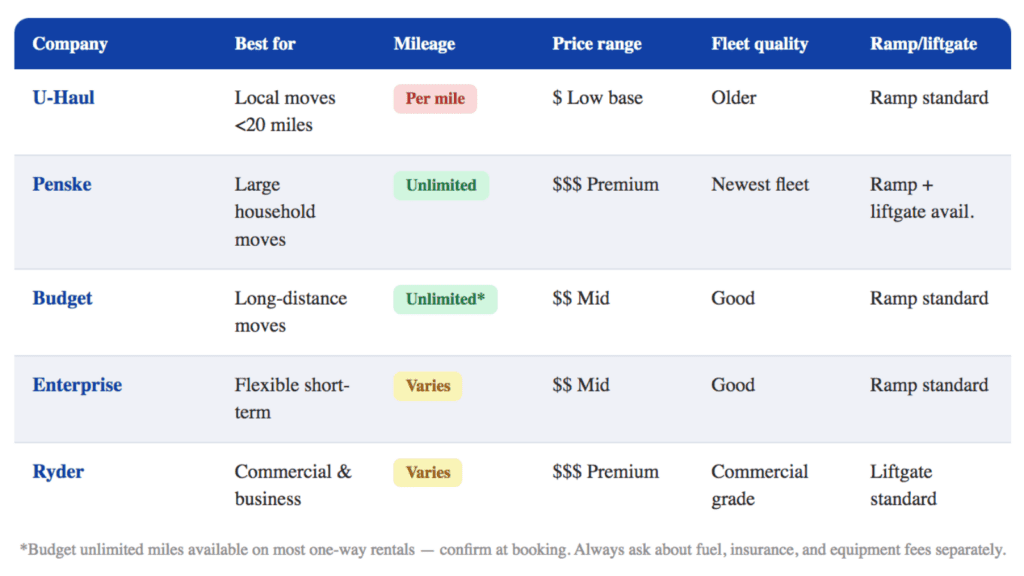
Quick Comparison at a Glance
- U-Haul: Best for local moves under 20 miles. Per-mile pricing. Massive location network.
- Penske: Best for large households. Newer trucks. Unlimited miles on most one-way rentals.
- Budget: Best for long-distance. Unlimited miles. Lower base rates.
- Enterprise: Best for flexibility. Smaller fleet. Strong customer service.
- Ryder: Best for commercial and business moves. Commercial-grade fleet.
Questions You Must Ask Before Booking Any Moving Truck
The price you see advertised is almost never the price you pay. Before confirming any reservation, ask these questions explicitly — do not assume the answers.
1. Are miles unlimited, or is there a per-mile charge?
This is the single most important question for any move over 50 miles. A $200 base rate with a $0.89 per-mile charge becomes $1,090 on a 1,000-mile move. Always ask for the total estimated cost with mileage included, not just the base rate.
2. What additional charges apply?
Beyond mileage, moving truck rentals often include extra charges that are not obvious at booking. Ask specifically about:
- Fuel — most companies require you to return the truck with the same fuel level or charge a premium refueling fee
- Insurance and damage waivers — often presented as optional but strongly encouraged
- Environmental fees, taxes, and facility charges
- Tolls — some companies track tolls automatically and bill your card after return
3. Does the truck have a liftgate or loading ramp?
Not all trucks come equipped the same way. A liftgate (a hydraulic platform at the rear of the truck) is essential if you're moving heavy appliances, furniture, or items that cannot be carried up a ramp. A loading ramp is sufficient for most household moves. Confirm which your truck has, and whether there is an additional charge for a liftgate-equipped vehicle.
4. How many days does the rental include for a long-distance move?
A cross-country move is not a one-day rental. Most companies calculate the allowed rental period based on the distance of the move, but the formula varies. Ask explicitly how many days are included in your quote, what happens if you need an extra day, and what the per-day overage charge is. For long moves, build in buffer days — mechanical issues, weather delays, and loading taking longer than expected are all common.
5. What does it cost to rent blankets, dollies, and moving equipment?
Furniture blankets (also called moving pads), appliance dollies, and hand trucks are almost never included in the base rental price. Renting them from the truck company can add $30 to $80 or more to your total. If you need a full set of moving blankets for a large household move, the rental cost from U-Haul or Penske can be surprisingly steep — especially when there is a much better option available. Learn more about moving boxes.
The Harbor Freight Secret: Professional Moving Blankets for a Fraction of the Cost
One of the best-kept tips in the moving industry is buying moving blankets from Harbor Freight instead of renting them from the truck company. Harbor Freight sells professional-grade moving blankets that are the same quality used by moving companies — thick, heavy woven fabric that actually protects furniture — at a fraction of what you'd pay to rent comparable blankets over a multi-day move.
The key is the coupon. Harbor Freight almost always has active coupons — typically 40% off — available on their website, app, or through email signup. A set of 12 professional moving blankets that might retail for $60 can often be purchased for $35 to $40 with a coupon applied. That is less than you'd pay to rent the same number of blankets for a single day from a truck rental company.
Even better: after your move, professional moving blankets have real resale value. Moving companies that operate out of your destination market regularly buy used blankets from private sellers — they use them to offload trucks, pad storage units, and protect items in transit. Many local movers and moving companies will purchase a clean set of used moving blankets directly from you. Check with local moving companies in your destination city, or list them on Facebook Marketplace — they sell quickly.
The net result: you protect your furniture better than rental blankets would, you spend less upfront, and you recoup some of the cost afterward. It is one of the few moving tips that genuinely saves money at every step.
Final Tips Before You Book
- Book as early as possible. Moving truck availability drops sharply on weekends and at the end and beginning of each month — the most popular moving times. Booking two to four weeks in advance gives you better pricing and vehicle selection.
- Get the total cost in writing. Ask for an itemized estimate that includes base rate, mileage, estimated fuel, equipment, taxes, and fees. A verbal quote is not enough.
- Inspect the truck before driving away. Document every existing scratch, dent, and scuff with photos or video before you leave the lot. This protects you from being charged for damage you did not cause.
- Consider fuel costs as part of the total. Large moving trucks get 8 to 12 miles per gallon. On a 1,000-mile move, budget for 80 to 125 gallons of fuel — that is $300 to $500 at current prices, in addition to the rental cost.
- Ask about one-way vs. round-trip pricing. If you are not returning the truck to the original location, confirm that the one-way rate is available for your specific route. Rates and mileage policies can differ significantly between one-way and round-trip rentals.
The bottom line: the right truck rental company depends on your specific move. U-Haul wins on convenience for short local moves. Penske delivers the best experience for large household moves. Budget is the smart play for long-distance unlimited-mileage moves. And whatever company you choose, skip the rental blankets and head to Harbor Freight first. Find the best long distance movers.
Moving Truck Size Calculator
Answer a few quick questions to estimate the truck size you may need.