










How Gas Prices Are Affecting Moving Companies in 2026
Rising gas and diesel prices are having a direct impact on the moving industry in 2026. As fuel costs surge, moving companies are adjusting pricing models, adding or increasing fuel surcharges, and passing a portion of these costs on to customers.
While fuel has always been a factor in moving costs, recent volatility is accelerating price changes across both local and long-distance moves.
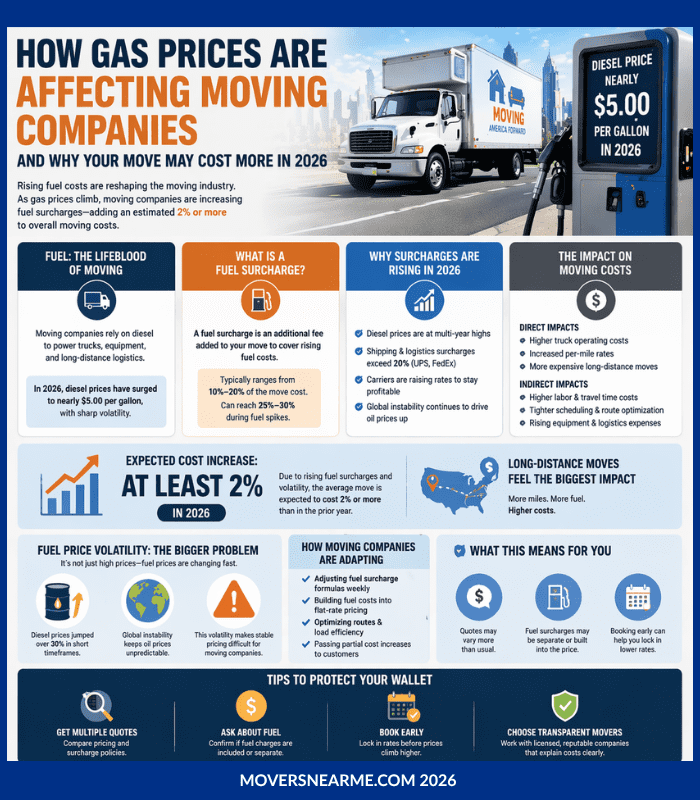
Why Fuel Costs Matter in the Moving Industry
Moving companies rely heavily on trucks, logistics, and long-distance moving—all of which depend on diesel fuel.
In 2026:
- Diesel prices have surged close to $5 per gallon
- Prices have increased significantly in a short period of time
Because of this, fuel is no longer a small operational expense—it’s a major cost driver.
What Is a Fuel Surcharge?
A fuel surcharge is an additional fee added to a moving estimate to account for fluctuations in fuel prices.
- Typically ranges from 10–20% of the move cost
- Can rise to 25–30% during fuel spikes
These surcharges allow moving companies to stay operational without constantly adjusting base pricing.
Why Fuel Surcharges Are Increasing in 2026
Fuel surcharges are rising across all transportation sectors—not just moving.
- Shipping companies like UPS and FedEx have increased fuel surcharges above 20%
- Carriers are actively raising both base rates and fuel surcharge percentages
This trend is now fully impacting moving companies, especially those handling long-distance and cross-country relocations.
How This Impacts Moving Costs
Fuel increases don’t just affect one part of your move—they impact the entire operation.
Direct Cost Increases
- Higher cost to operate trucks
- Increased long-distance transportation expenses
- Higher per-mile rates
Indirect Cost Increases
- Labor costs rise due to longer travel times
- Scheduling becomes tighter as routes are optimized for efficiency
- Equipment and logistics costs increase
Expected Increase in Moving Costs
Based on current fuel trends and surcharge adjustments, moving costs are expected to rise.
What to Expect:
- Average moving costs may increase by ~2% or more in the near term
- Long-distance moves will feel the biggest impact
- Peak season pricing may amplify these increases
Even small percentage increases can add hundreds of dollars to a move—especially on cross-country routes.
Why Long-Distance Moves Are Hit the Hardest
Fuel plays a much bigger role in long-distance moves than local ones.
- A 1,000–2,000 mile move significantly increases fuel consumption
- Even minor per-mile increases compound quickly
- Route demand + fuel = pricing pressure
This is why many customers are seeing larger quote variations in 2026. Learn more about average moving costs.
Fuel Volatility Is the Bigger Issue
It’s not just high fuel prices—it’s how quickly they’re changing.
- Diesel prices have jumped more than 30% in short timeframes
- Oil prices have surged due to global instability
- Transportation industries are reacting in real time
This volatility makes it harder for movers to lock in stable pricing.
How Moving Companies Are Adapting
To stay competitive and operational, moving companies are:
- Adjusting fuel surcharge formulas weekly
- Building fuel costs into flat-rate pricing
- Optimizing routes and load efficiency
- Passing partial cost increases to customers
Fuel surcharge programs are designed to keep service reliable during volatile conditions
What This Means for Customers
If you’re planning a move in 2026, fuel costs are something you need to factor in.
Key Takeaways:
- Quotes may vary more than usual
- Fuel surcharges may be listed separately or built into pricing
- Waiting to book could result in higher costs
How to Protect Yourself From Price Increases
- Get multiple quotes and compare breakdowns
- Ask if fuel is included or separate
- Book early to lock in pricing
- Work with transparent, verified movers
Final Thoughts
Fuel prices are one of the biggest hidden drivers of moving costs in 2026. As diesel prices rise and volatility continues, fuel surcharges are becoming a standard part of pricing—and are expected to push moving costs up by at least 2%.
Understanding how fuel impacts your move can help you budget more accurately, avoid surprises, and choose the right company.
Recommended Reading: